
Climate change is increasingly driving organizations to understand and manage their environmental impact. As a result, GHG emissions have become an important part of sustainability management.
For companies, managing GHG emissions involves more than calculating the amount of emissions they generate. Instead, emissions data can help organizations develop reduction strategies, improve operational efficiency, meet customer and regulatory requirements, and support sustainability targets.
Learn more about GHG emissions and climate change mitigation.
What Are GHG Emissions?
Greenhouse Gas Emissions, commonly known as GHG emissions, refer to the release of greenhouse gases into the atmosphere.
These emissions can result from human activities and natural processes. In business operations, organizations commonly account for several types of greenhouse gases.
These include:
- Carbon Dioxide (CO₂)
- Methane (CH₄)
- Nitrous Oxide (N₂O)
- Hydrofluorocarbons (HFCs)
- Perfluorocarbons (PFCs)
- Sulfur Hexafluoride (SF₆)
- Nitrogen Trifluoride (NF₃)
Because these gases have different impacts, organizations generally convert them into tonnes of CO₂ equivalent (tCO₂e). This approach makes it easier to measure and compare emissions consistently.
Why Should Companies Measure GHG Emissions?
The first step in managing emissions is to understand how much an organization emits. In addition, companies need to identify where emissions come from and which activities contribute the most.
Therefore, measuring GHG emissions can help companies:
Identify Major Emission Sources
First, companies can identify activities that contribute significantly to their total emissions.
This information helps organizations understand their main emission sources and establish priorities for further action.
Identify Emission Reduction Opportunities
Next, accurate emissions data can help companies identify areas with the greatest potential for reduction.
As a result, organizations can focus resources on initiatives that address significant emission sources.
Improve Operational Efficiency
In addition, reducing energy, fuel, or material consumption can support environmental performance.
At the same time, these initiatives may improve operational efficiency and reduce costs.
Meet Customer and Stakeholder Requirements
Furthermore, customers and business partners increasingly request emissions data from suppliers.
This information can support sustainability programs, supply chain management, and customer due diligence.
Support Sustainability Reporting and Targets
Finally, a structured GHG inventory can support sustainability reporting.
It can also provide a baseline for setting emission reduction targets and monitoring progress over time.
What Are Scope 1, Scope 2, and Scope 3 Emissions?
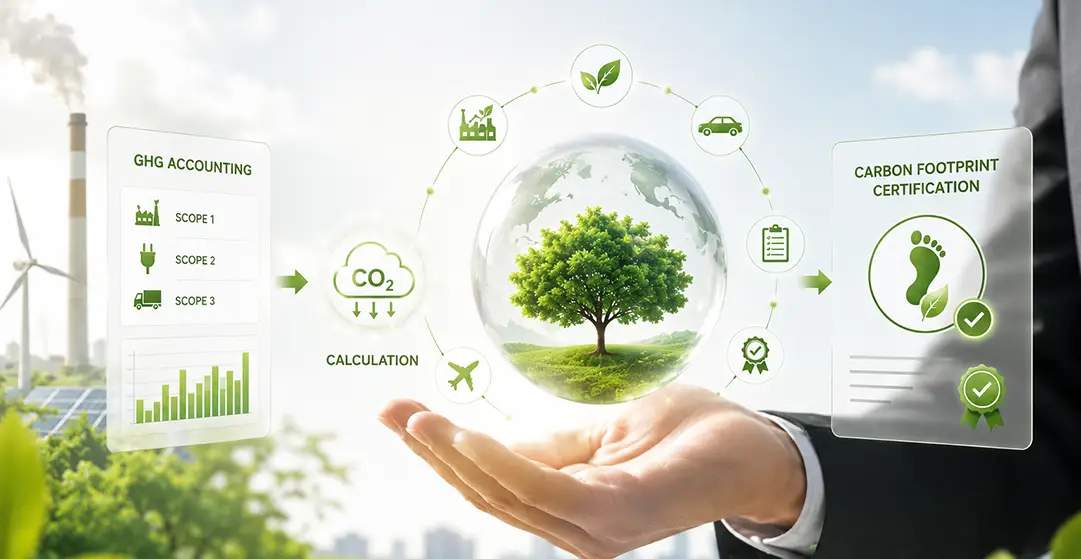
Organizations generally categorize GHG emissions according to their sources. These categories are known as Scope 1, Scope 2, and Scope 3.
Understanding these three scopes is important because each one covers a different type of emission source.
Scope 1: Direct Emissions
Scope 1 includes direct emissions from sources that an organization owns or controls.
For example, these emissions can come from:
- Fuel combustion in boilers or furnaces
- Fuel consumption from operational vehicles
- Production processes
- Fugitive emissions from refrigerants
Therefore, Scope 1 focuses on emissions directly generated by the organization’s controlled activities.
Scope 2: Energy Indirect Emissions
Scope 2 covers indirect emissions from purchased and consumed energy.
This category commonly includes:
- Electricity
- Steam
- Heat
- Cooling
For example, a company may purchase electricity from the grid. The emissions associated with generating that electricity can then be accounted for as Scope 2 emissions for the organization.
Scope 3: Other Indirect Emissions
Scope 3 covers other indirect emissions throughout an organization’s value chain.
These emissions may come from activities such as:
- Purchased goods and services
- Capital goods
- Transportation and distribution
- Business travel
- Employee commuting
- Use of sold products
- End-of-life treatment of sold products
However, Scope 3 can be more challenging to measure. Organizations often need data from multiple activities, suppliers, customers, and other business partners.
How Does a GHG Inventory Support Emission Management?
Calculating emissions is an important first step. However, measurement alone is not the final objective.
Once an organization establishes its GHG inventory, it can identify emission hotspots and determine an appropriate baseline.
The organization can then set targets and develop emission reduction programs.
A practical approach is:
Measure → Identify → Reduce → Monitor → Improve
Therefore, companies should base their emission reduction programs on traceable data and consistent methodologies.
Potential initiatives may include:
- Improving energy efficiency
- Using renewable energy
- Reducing fuel consumption
- Optimizing production processes
- Reducing waste
- Changing raw material sources
- Improving transportation efficiency
- Managing refrigerants
- Implementing low-carbon technologies
What Is a Carbon Footprint?
A carbon footprint helps organizations understand the greenhouse gas emissions associated with an activity, product, or service.
Therefore, assessing a carbon footprint can provide additional insight into an organization’s environmental impact.
It can also help companies identify areas where emission reductions may be possible.
Learn more about carbon footprint services from CBQA Global.
Why Is GHG Verification Important?
In addition to calculating emissions, organizations may consider GHG verification to strengthen the credibility of reported GHG information.
Verification provides a level of assurance that the reported information has been prepared against defined criteria. It also considers whether the information contains material misstatements within the objectives and limitations of the engagement.
As a result, GHG verification can help organizations strengthen:
- Credibility of GHG information
- Transparency
- Data reliability
- Stakeholder confidence
- Readiness for customer or regulatory requirements
What Are ISO 14064-1 and ISO 14064-3?
Organizations can use relevant standards to support their GHG management processes.
ISO 14064-1 provides a reference for developing and reporting an organization’s GHG inventory.
Meanwhile, ISO 14064-3 provides principles and requirements related to the validation and verification of GHG statements.
Therefore, these standards can support organizations in developing a more structured approach to GHG quantification, reporting, validation, and verification.
How Do GHG Emissions Support a Sustainability Strategy?
GHG emissions management should not operate as a standalone environmental initiative.
Instead, organizations can integrate emissions data into their broader business and sustainability strategies.
For example, understanding major emission sources can help companies:
- Determine investment priorities
- Improve resource efficiency
- Identify reduction opportunities
- Respond to customer requirements
- Prepare for climate-related policies
As a result, organizations can use emissions data to support both environmental and business objectives.
Ultimately, “you cannot effectively manage what you do not measure.”
By measuring GHG emissions, companies can establish a clearer understanding of their carbon footprint. From there, they can develop more measurable, transparent, and sustainable emission reduction strategies.
Start with Data, Move Toward Emission Reduction
The journey toward a lower-carbon organization starts with understanding where you are today.
First, organizations need reliable GHG data. Next, they need a structured GHG inventory and traceable information.
After that, they can identify emission hotspots, establish targets, implement reduction initiatives, and monitor progress.
This approach creates a clearer path from measurement to meaningful action.
Measure your emissions. Understand your impact. Take action.
Need Support for GHG Verification?
CBQA Global provides Verification & Validation services to support organizations in strengthening the credibility of sustainability information and data according to relevant standards and criteria.
If your organization needs support with GHG Verification, GHG Inventory, ISO 14064-1, or ISO 14064-3, the CBQA Global team can help you understand the relevant requirements and processes.
Contact CBQA Global for More Information
Email: info@cbqaglobal.com
Email Marketing: marketing.cbqaglobal@gmail.com
WhatsApp: 08118468777
Phone: +62 21 2781 4200
CBQA Global. We Inspire in Trust.
Certification | Audit | Training | Sustainability