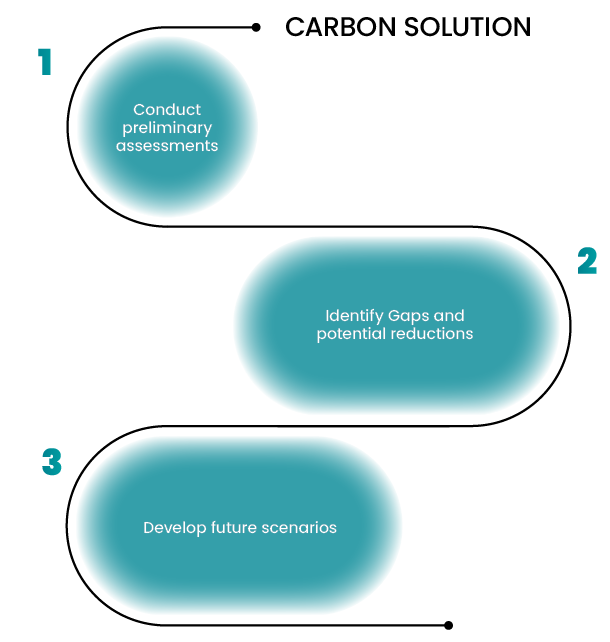
We provide service for preliminary assessment for existing carbon/GHG emission including its reduction initiatives/project under proposed scenarios. We also provide preliminary assessment against desired compliance frameworks, including Pre-Feasibility Study, Risk Assessment and Cost Benefit analysis/assessment. We also provide review for Life Cycle Assessment (LCA) report
Methodology assessment, assess current and future business-as-usual scenarios and develop future pathways for carbon reduction projects, including providing key metrics and indicators for high-level decision-making. Methodology asessment can be broader scope than just the Preliminary Assessment. It includes future insight and possibilities, including SWOT analysis, GAP analysis, etc for your carbon / GHG emission reduction project

Develop actionable carbon reduction plans
Refine operations for sustainability
Meet market and regulatory requirements
Business-as-usual baseline emissions.
It includes baseline emissions analysis, gap identification, and recommendations for improvement.
Yes, CBQA Global develops strategic plans to align with net-zero objectives.
Ideally, reassessments should occur every 2–3 years or after significant operational changes.
Yes, CBQA Global tailors assessments to industry-specific emissions challenges and opportunities.
No, to maintain impartiality, CBQA Global performs only one of these services. If a company / a client requires CBQA Global to assist reporting, then CBQA Global cannot perform validation/verification/certification for the same report and/or same client/company.
Search across ISO Certification, Audit, Training, and Sustainability to find the right services for your organization.
ICR
JCM
SPEI
Have a project in mind?
Connect with our team to identify the right approach across Certification, Audit, Training, Sustainability. We support organizations in strengthening management systems and achieving measurable business outcomes.
Get expert ISO certification, audit, training, and sustainability services to strengthen governance, improve compliance, reduce risk, and drive measurable business performance.