
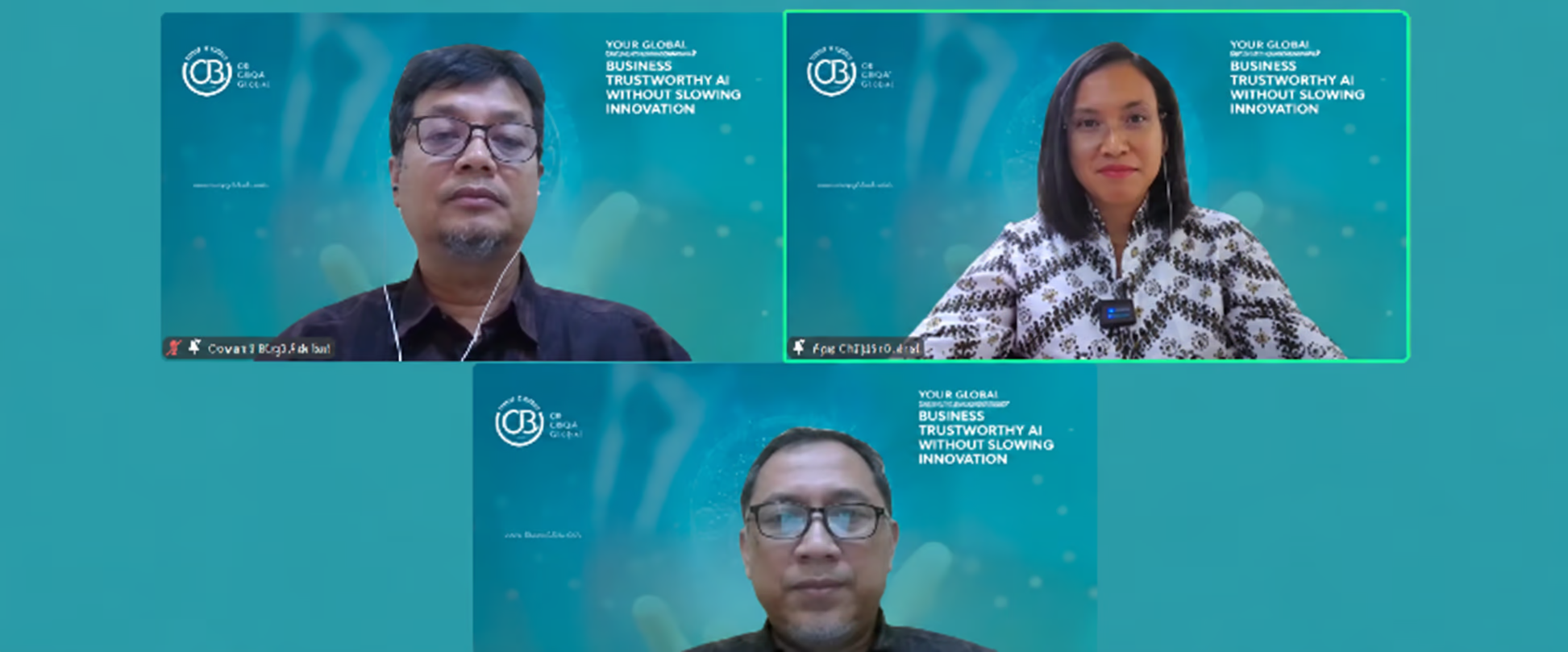
Artificial Intelligence (AI) is increasingly being used to improve operational efficiency, support data analysis, and accelerate decision-making. However, do organizations have the right governance framework in place to ensure that AI is used safely, responsibly, and reliably?
This question was at the heart of CBQA Global’s free webinar, “Your AI Is Smart. But Is It Governed? Building Trustworthy AI Without Slowing Innovation,” held on November 17, 2026.
Through this webinar, participants explored the importance of ISO/IEC 42001 as the international standard for an Artificial Intelligence Management System (AIMS), as well as how organizations can manage AI-related risks without slowing business innovation.
What Is ISO/IEC 42001 and Why Does AI Governance Matter?
ISO/IEC 42001:2023 is an international standard that specifies requirements for establishing, implementing, maintaining, and continually improving an Artificial Intelligence Management System (AIMS).
The standard helps organizations systematically manage AI-related risks and opportunities across the development, provision, and use of AI technologies. Its approach covers governance, organizational responsibilities, risk assessment, controls, and continual improvement.
As explained by the International Organization for Standardization (ISO), ISO/IEC 42001 provides a framework for responsible AI management while supporting innovation and trust. Read the official ISO/IEC 42001 overview.
AI Risks Organizations Need to Address
While AI offers significant benefits, its use also introduces risks that can affect information security, privacy, reputation, and business decision-making.
During the webinar, several key risks were discussed, including AI hallucinations, bias and discrimination, data leakage, Shadow AI, model drift, and third-party risks.
For example, employees may enter confidential financial information into personal AI accounts without the organization’s knowledge. AI systems may also generate inaccurate contract summaries or produce biased recommendations due to unrepresentative training data.
These situations demonstrate that AI governance cannot rely solely on technology usage policies. Organizations need to understand how AI is being used, establish clear responsibilities, and ensure that risks are managed throughout the system lifecycle.
How Can Organizations Build Effective AI Governance?
One approach discussed during the webinar was classifying AI risks based on the potential impact of each use case. High-risk applications, such as credit decisions, hiring automation, and medical advice, require human oversight, model validation, bias testing, and appropriate approval processes.
Meanwhile, medium- and low-risk AI applications can be managed through proportionate controls, such as output monitoring, data masking, acceptable use policies, and security awareness training.
Security and privacy controls should also cover AI inputs and outputs. These include prompt filtering, data masking, logging, vendor assessments, and integration with existing controls within the organization’s information security management system.
This approach aligns with the NIST AI Risk Management Framework, which uses four core functions: Govern, Map, Measure, and Manage. These functions help organizations manage AI risks continuously. Explore the NIST AI RMF.
Integrating AI Governance with Information Security and Privacy
AI Governance does not have to operate as a separate management system. Organizations can leverage existing management frameworks, including ISO/IEC 27001 for information security and ISO/IEC 27701 for privacy information management.
This integration can be implemented through risk registers, access controls, vendor assessments, incident management, and AI impact assessments.
For AI impact assessments, ISO/IEC 42005:2025 can also serve as a useful reference. This standard provides guidance on identifying, evaluating, and documenting the impacts of AI systems on individuals, groups, and society. Learn more about ISO/IEC 42005:2025.
In Indonesia, organizations should also ensure that their AI governance practices align with applicable personal data protection requirements, including Law No. 27 of 2022 on Personal Data Protection (UU PDP).
AI Governance Challenges Raised During the Webinar
The question-and-answer session highlighted that organizations are beginning to face more specific challenges in implementing AI Governance.
Participants raised questions about conducting security assessments of MCP, connectors, and AI skills; integrating ISO/IEC 42001 with ISO/IEC 27001, ISO/IEC 27701, and the NIST AI RMF; and managing the risks associated with public AI tools.
Other topics included the importance of AI Impact Assessments, the competencies required of personnel responsible for managing AI, and the relationship between AI Governance and personal data protection regulations.
These discussions show that organizational needs go beyond simply selecting the right technology. Clear responsibilities, appropriate competencies, documented controls, and ongoing risk assessments are essential to building an accountable AI governance framework.
Build Trustworthy AI Governance with CBQA Global
Intelligent AI systems are not necessarily trustworthy without proper governance. Organizations need to ensure that every AI application has a clear purpose, identified risks, and appropriate controls.
Through ISO/IEC 42001, organizations can establish a more structured Artificial Intelligence Management System, strengthen accountability, and support responsible innovation.
CBQA Global supports organizations in understanding their ISO/IEC 42001 implementation and certification needs as part of strengthening their AI governance framework.
Contact CBQA Global to discuss your organization’s AI Governance and certification needs.
Email: [email protected]
WhatsApp: +62 811 8468 777
Website: www.cbqaglobal.com
CBQA Global | We Inspire in Trust.
Certification | Audit | Training | Sustainability